
Best Barefoot Shoes for Wide Feet: A Wide Toe Box Fit Guide
Most people can tell when a shoe is too short. Width is harder to diagnose. A shoe can be long enough and still press your toes together, rub the side of your forefoot, or leave a deep line across the top of your foot by the end of the day.
That does not automatically mean you need an extra-wide shoe. Sometimes the shoe is narrow through the toes rather than narrow across the whole foot. Sometimes your foot has a high instep. Sometimes the size is simply wrong. This guide helps you separate those problems before you buy another pair.

What Counts as a Wide Foot?
A wide foot is wider than the standard width used for your shoe size. It is not a diagnosis, and it does not have one universal measurement. Shoe brands use different lasts, and a men's D and a women's D do not mean the same thing.
The useful question is not "Do I have wide feet compared with everyone else?" It is "Does my foot fit the shape and width of the shoe I am wearing?"
You may have a wide foot if:
- The sides of your shoes bulge or stretch around the forefoot.
- Your little toe sits on the shoe's edge instead of inside the upper.
- You get pressure marks across the ball of your foot after a normal day.
- You regularly choose a longer size just to create more room at the front.
- Several pairs fit your heel but pinch at the toes.
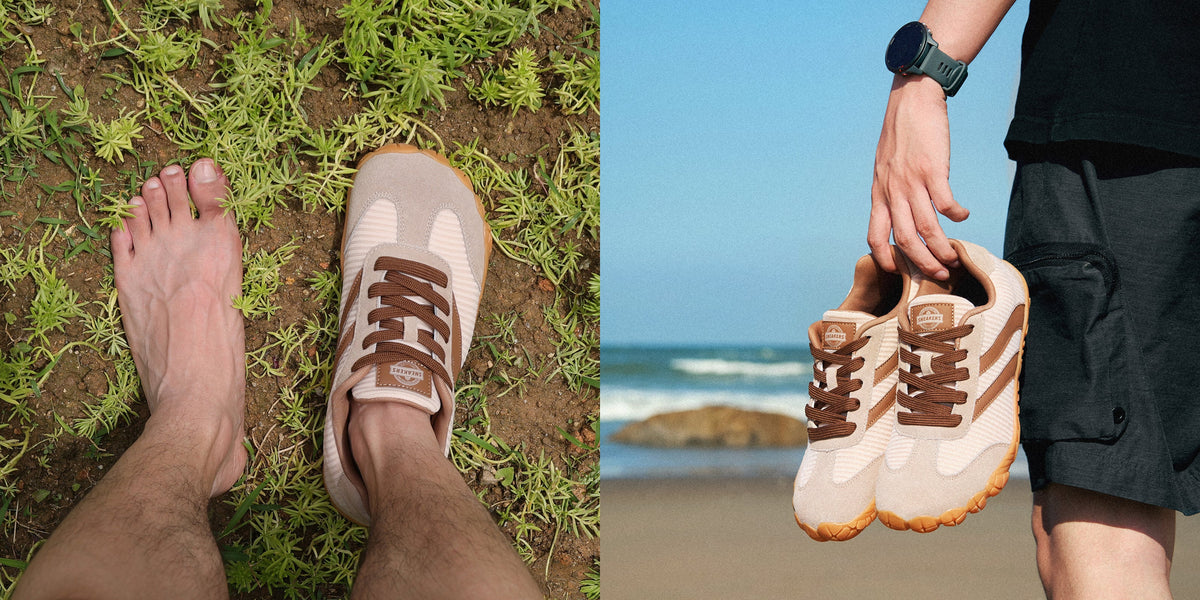
A wide foot can be wide at the ball of the foot, the toes, the midfoot, or all three. That distinction matters. A wider shoe often adds room through the whole shoe. A foot-shaped shoe adds room where many feet need it most: at the toes.
How to Tell if You Have Wide Feet: The Two-Minute Paper Test
You do not need a Brannock device to get a useful starting point. A sheet of paper, a pen, and the socks you usually wear are enough.
Step 1: Trace Both Feet
Put the paper on a hard floor with one edge against a wall. Stand with your heel lightly touching the wall and your weight spread naturally over both feet. Have someone trace around each foot, or do it yourself while keeping the pen upright.
Do not trace while sitting. Your foot spreads under body weight, which is the shape your shoe needs to accommodate.
Step 2: Mark Your Widest Points
Measure straight across the widest part of each outline. For many people, that is near the ball of the foot. If your toes spread wider than the ball, measure there as well. Record the larger number from both feet.
Feet are often slightly different sizes. Buy for the larger foot.
Step 3: Compare Width and Length Separately
Measure heel to longest toe, then compare both measurements with the specific brand's size chart. Do not assume your usual numerical size tells the whole story. A size chart may list length only, or it may use width letters such as B, D, EE, 2E, 4E, and 6E.
If your length is right but the upper pulls sideways, you likely need more width. If the shoe feels fine at the ball but your toes are crowded together, a wider toe box may be more useful than a shoe that is simply wider everywhere.
Step 4: Repeat Later in the Day if a Shoe Only Feels Tight at Night
Feet commonly take up more space after walking, standing, heat, or a long day. If you are shopping for work shoes or walking shoes, measure in the afternoon or evening as well. Use the larger measurement when the difference is noticeable.
Do You Actually Need Wide Shoes?
Not every cramped shoe means you need a wide fit. Before changing widths, check these four possibilities.
Your Shoe May Be Too Short
A short shoe can make the forefoot feel wide because the shoe narrows as it tapers toward the toes. Check for about a thumb's width of space in front of your longest toe when standing. If there is no room, shoe length may be the first problem.
Your Shoe May Be Narrow at the Toe Box
A conventional shoe can be roomy around the ball of the foot and still narrow sharply toward the toes. That is why some people say a wide shoe feels loose at the heel but still wrong at the front.
For that situation, look at the outline of the shoe from above. Does it continue to follow the shape of your toes, or does it narrow into a point? Wide toe box shoes are designed to leave room at the front rather than asking the toes to line up in a narrower shape.
You May Have a High Instep
If the pressure is on top of your foot rather than at the sides, width may not fix it. Try different lacing, a shoe with a deeper upper, or a model made for a high instep. Going wider can help in some cases, but it can also leave too much room at the heel.
Your Socks or Insoles May Be Changing the Fit
Thick socks and bulky insoles take up space quickly. Test a shoe with the socks you will actually wear. If you use an insole, bring it when trying shoes on instead of assuming the stock insole and your own will feel the same.
Shoe Width Letters Explained: B, D, EE, 2E, 4E, and 6E
Shoe width letters are a sizing system, not a measure of how much toe room a shoe has. The same letter can fit differently across brands, so always treat it as a starting point.
| Width label | What it usually means | What to remember |
|---|---|---|
| B | A common standard width for women's shoes | In many men's ranges, B is narrow. |
| D | A common standard width for men's shoes | In many women's ranges, D is wide. |
| EE or 2E | Extra width beyond D | Often used for men's wide shoes. |
| 4E | Extra-extra width | Often used for very wide men's styles. |
| 6E | One of the widest commonly listed options | Availability varies by brand. |
The labels can be confusing because they depend on who the shoe was designed for. A women's D is generally wider than a women's B. A men's D is generally the standard width in men's sizing. That is why it helps to read the brand's own chart rather than search for one universal answer to what a width letter means.
If a chart gives only letters, ask the brand for the actual width measurement at your size. A good chart shows the relationship between shoe length and width. Your foot does not stay the same width across every size.
How to Use a Shoe Width Chart
Start with your measured foot length and width. Find the length first, then check which width range includes your wider-foot measurement.
- Measure both feet and use the larger foot.
- Compare the chart with your usual sock thickness.
- Do not size up in length just to get width unless the brand recommends it.
- Treat D versus EE as a width choice, not as a quality ranking.
- Recheck after pregnancy, injury, a major weight change, or long periods on your feet. Feet can change over time.
You may see terms such as regular, medium, wide, extra wide, 2E, 4E, and XX-wide. They are not perfectly interchangeable across brands. A "wide fit" model may only add a small amount of space. A 2E shoe usually follows a specific width system, but the shoe's last and upper material still affect how it feels.

Wide Shoes vs. Wide Toe Box Shoes
This is the part most people miss. A wide shoe is wider through the shoe's overall structure. That may be what you need if the whole forefoot and midfoot feel squeezed. A wide toe box shoe is shaped to give the toes more room, even when the heel and midfoot stay secure.
| A wide toe box may suit you when... | A wider overall shoe may suit you when... |
|---|---|
| Your toes feel compressed but your heel does not need extra room. | The upper pulls across the ball of your foot. |
| Your smallest toe rubs against the side of the upper. | The midfoot feels compressed. |
| You want your toes to spread naturally when you walk. | Your foot spills over the insole along both sides. |
| You are tired of buying longer shoes to escape a pointed front. | The shoe feels tight before you reach the toe area. |
Some people need both: a wider shoe and a wider toe box. There is no prize for squeezing into a standard width. The right fit should hold your heel without asking your toes to do the same job.
For a closer look at the shape, sole, and zero-drop platform that define barefoot shoes, read our complete guide to barefoot shoes.

A Quick Fit Checklist Before You Buy
- Stand in both shoes, not just one. Your feet should have space when you are bearing weight.
- Wiggle every toe. The smallest toe matters too.
- Walk for a few minutes. A shoe that feels fine standing still can rub once your foot moves forward.
- Check the heel. More forefoot room should not mean your heel slides out.
- Look at the upper from above and from the side. It should not pull tightly across your foot.
- Try the socks you will wear most often.
- If you are between widths, choose the fit that lets your foot relax rather than the one that needs time to "break in."
A shoe can soften with wear. It rarely becomes a different shape. If the toe box points inward or your toes are already pressed together in the shop, do not expect the fit to improve enough later.
Frequently Asked Questions
How do I know if I need wide shoes?
You may need wide shoes if your length is correct but the sides of the shoe pinch, your forefoot overhangs the insole, or the upper leaves repeated pressure marks. Measure your foot while standing and compare it with the brand's width chart.
What is considered a wide foot?
A foot is considered wide when its measurement falls outside the standard width range for its length in a particular brand's chart. There is no single measurement that applies to every shoe size and every brand.
Is a wide shoe the same as a wide toe box shoe?
No. A wide shoe usually adds room across more of the shoe. A wide toe box focuses on room for the toes. Depending on your foot shape, you may need one or both.
Should I size up if I have wide feet?
Not by default. Sizing up may add a little width, but it also changes the length and can let your foot slide forward. Check whether the brand offers a wider width or a foot-shaped toe box first.
What does EE mean in shoe size?
EE, often written as 2E, usually means a wider option than D. The exact measurement depends on the brand, the shoe type, and the size.
The Goal Is Room Where Your Foot Needs It
Finding the right width is less about chasing a letter and more about noticing where a shoe fails you. Measure both feet, compare width and length separately, and pay attention to the shape at the toes.
If you have spent years assuming your feet are the problem, start with the shoe. A better fit should make walking feel less like a negotiation with every step.
Explore BareFrog's wide toe box barefoot shoes and use your measurements to find the option that suits your forefoot, midfoot, and heel together.
Research & Further Reading
View sources
This source provides background on how much forefoot width can vary even within a single shoe size. It is included for educational purposes and does not constitute medical advice or product endorsement.
- Foot dimensions and shape variability in a large European adult population, Scientific Reports, 2021.