
This is a short essay from the BareFrog team. We make barefoot shoes for a living; in conversations with new customers, podiatrists, and friends who think we are slightly out of our minds, we keep returning to the same questions. This essay is a longer version of those conversations.
If a shoe looks like it could go on a runway and on a trail in the same weekend, we have probably already sent the prototype back to the drawing board.
What is a barefoot shoe, really?
Strip the marketing off and you get something almost embarrassing: a shoe with a wide front, a flat sole, no spring in the heel, and almost nothing between your foot and the ground. That is the whole idea. Everything else in this essay is either a way of describing that shape, or a way of explaining why almost no one on the high street wants to sell it.
We use the word "barefoot" because the industry does, not because we think the shoe is a spiritual object. It is a tool. A foot-shaped tool. Wear it when you want to feel like you are walking more and padding less.
It starts with a foot, not a shoe
Before the shoe, there is a foot. A foot that, before age five or so, has not seen the inside of anything stiff. The toes splay. The arch is a soft curve, not a bridge. The heel touches down a little before the ball, and the whole foot knows where the ground is.
Then we hand the foot a pair of shoes. Cushion, arch, raise, narrow. The foot adapts. By thirty, most of us have a foot shaped by what it has worn, not by what it is.
The barefoot category, taken as a whole, is a quiet attempt to give the foot back some of what it lost. That is the entire pitch. There is no magic in it.
Four design marks
Marketing language around natural can be vague. At BareFrog, we use four design principles when developing our barefoot shoes. They are a practical checklist for the shape and feel we aim to create.
Wide toe box — widest at the metatarsals, no taper toward the little toes.
Zero drop — the heel and the forefoot sit at exactly the same height.
No built-in arch support (natural alignment) — the foot muscles do the lifting.
Thin, flexible sole (thin sole) — ground feel intact; puncture protection only where it counts.
For us, these four points are a useful way to describe the design. They help explain what we mean by a barefoot shoe and give readers a clear checklist when comparing options.
The architecture you already own
Twenty-six bones in each foot. Thirty-three joints. Over a hundred ligaments, tendons, and small stabilising muscles. The foot is not a soft pad; it is a structure that evolved to read ground, balance on uneven terrain, and push off without complaining about the weather.
What modern footwear tends to do is take that structure out of the loop. A cushioned midsole absorbs the signal. A rigid heel counter stabilises what does not need stabilising. A narrow toe box takes the toes out of the conversation. Each piece is sold as "support." None of it is wrong on its own. Stacked, it leaves the foot a passenger in its own shoe.
A barefoot shoe, deliberately, leaves the foot driving. That is the entire premise. There is no hidden feature.
Where the barefoot conversation actually started
In the public mind, the starting point was Christopher McDougall's Born to Run in 2009, which told the story of the Tarahumara in Mexico's Copper Canyons and the long-running argument that the 1972 cushioned-shoe revolution had not, in fact, made runners healthier.
Earlier than that, in the early 2000s, minimalist footwear began to gain broader attention. Over time, specialist labels and smaller makers helped expand the category. BareFrog is part of that wider conversation, and we are fine with that.
Twenty years on, the conversation is still small. That is the subject of the rest of this essay.
Two Olympic facts
That before any of us had a brand.
1960, Rome. Abebe Bikila wins the marathon barefoot. Cobblestones, dark, sub-Saharan Africa's first Olympic champion. No shoe technology involved.
1984, Los Angeles. Zola Budd, trained barefoot from childhood, runs for Britain and later South Africa. No one arranged this case study for them, but to this day, when a patient insists humans were not meant to run, the podiatrist still brings her up.
We mention them not as endorsements. We mention them because, before the category existed, the human foot was already performing at the highest level without anyone telling it what to wear.
Let the foot go outside
Grass, sand, wooden floors, packed dirt, the cool side of a tile you remember from a childhood kitchen. The foot is a sensory organ that has spent half a century being told the world is flat and uniform.
Take a barefoot shoe outside. Walk a kilometre down a path you have never noticed. What surprises people is the information density. A city pavement holds more texture than a cushioned sole has been letting through.
This is usually where we lose half the audience. The other half sends us emails. The split tends to happen within ten minutes of putting the shoe on.
An aesthetic we did not expect
What surprised us, making barefoot shoes for a living, was how much the fashion side of the industry has been quietly doing the same homework. Shoes that look like loafers and behave like barefoot. Shoes that look like ballet flats and read ground. A whole aesthetic vocabulary built around the foot's actual shape, not the shape a 1980s European last decided it should be.
Barefoot-inspired shoes come in many silhouettes, from trail-ready designs to casual everyday styles. The examples below describe broad design directions rather than comparing specific labels.
A few common design directions
Everyday barefoot sneakers:
Simple, flexible sneakers with roomy toe boxes and low profiles.
Lightweight trainers that pair a flexible sole with a sportier look.
Casual slip-ons with a flat profile and an understated upper.
Minimalist shoes with a polished, wardrobe-friendly silhouette.
Barefoot-inspired shoes with a more familiar feel:
Casual sneakers that pair a wide toe box with a conventional upper.
Lightweight everyday shoes with a flexible sole and understated styling.
Moccasin- or ballet-inspired silhouettes built around a foot-shaped last.
Minimalist shoes that balance simple styling with flexible construction.
These broad styles give you a sense of the design vocabulary before you decide what “barefoot” means for your own foot.
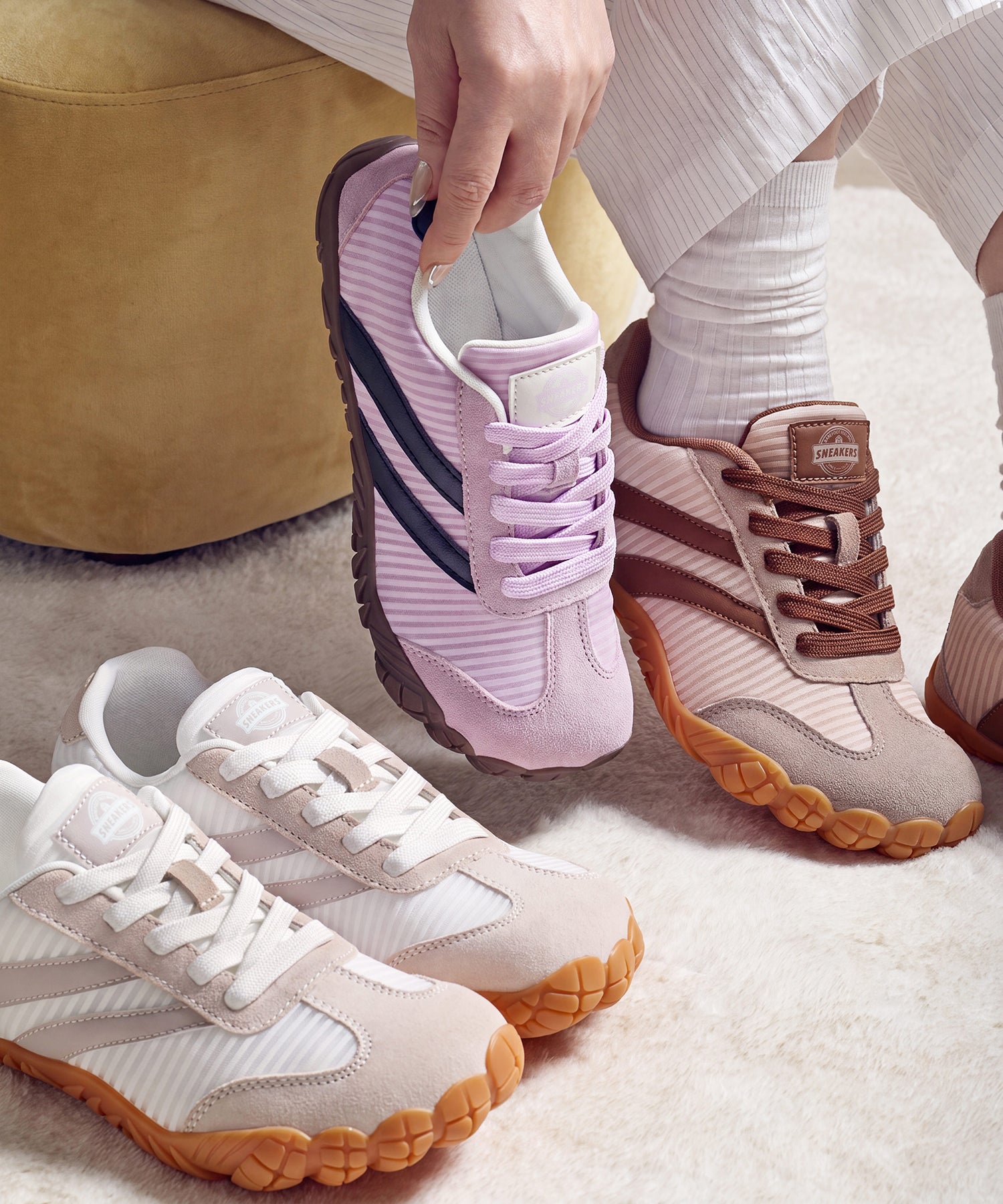
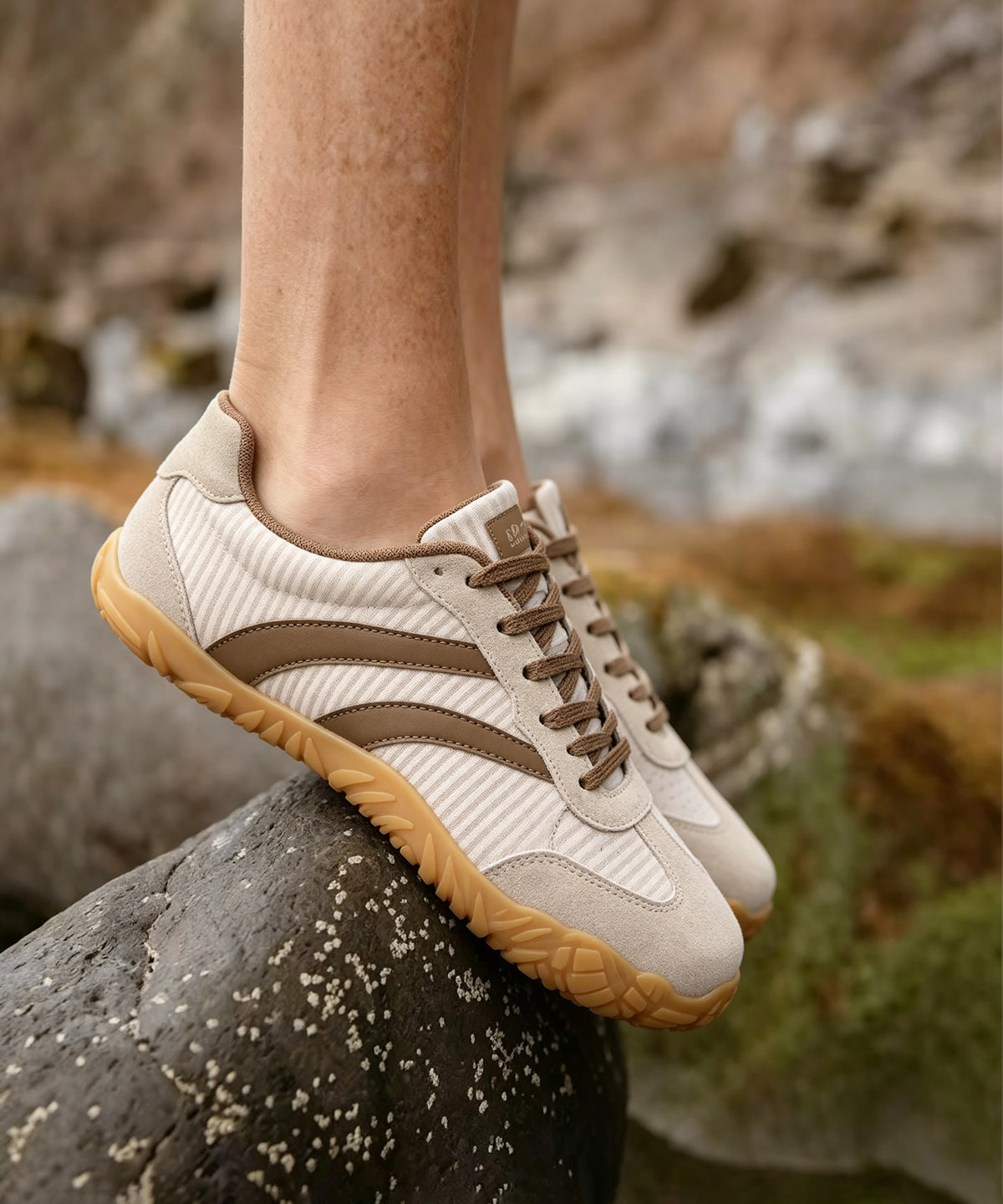
BareFrog's Libre line lives in this middle lane. We kept the barefoot DNA — wide toe box, zero drop, thin flexible sole — without the five-toe silhouette, so it does not look like a costume in a coffee queue. It is not the only answer. It is one we can stand behind.
Feet that should not start here
The notes below are general considerations for people exploring barefoot shoes; they are not a diagnosis or individualized medical guidance. If you have a foot condition, injury, or concerns about changing footwear, consult a qualified healthcare professional.
Active foot injury — plantar fasciitis, Achilles tendinitis, tibial stress, unhealed stress fracture, severe bunions.
Anyone walking long hours on hard concrete or tile with no transition plan.
Older adults with reduced balance or peripheral neuropathy, for whom a thin, ground-feeling sole raises fall risk.
Anyone who feels sharp pain in the first sessions — stop, and reassess with a clinician.
If none of the above applies to you, consider beginning with short sessions and increasing wear gradually as comfort allows. Adaptation varies from person to person; there is no need to rush.
The shoe on the shelf
Set next to the other shoes on the shelf, a barefoot shoe will always look a little odd. That is part of what it is. We are trying to fix it to make it a more daily one.
Three forces that keep it niche
We are asked why barefoot shoes are not in every mall. Honest answer: three structural reasons, and we are not sure any of them are fixable.
The brand-side dilemma
Most large athletic companies sell a story about new foam, new geometry, new tech. A barefoot shoe is the opposite story: less material, less intervention, less reason to upgrade every twelve months. Margins are thinner, the marketing narrative is harder, and the customer has to be educated. Big brands dip a toe in — sometimes literally — and pull back.
The slow-burn customer journey
Barefoot shoes can take time to get used to. Some people start with part-time wear and gradually increase it; the timeline varies with the person, shoe, and activity. A cushioned shoe can feel familiar in the shop on day one, so we encourage customers to take a gradual approach rather than expecting an immediate change.
The look
Toes spread out. A heel that is not raised. A sole that you can easily fold with one hand. To anyone raised on the cushioned aesthetic, the geometry reads as "unfinished." We have tried to dress the look up over the years. Some of those shoes appear elsewhere in this essay. None of them pretended to be something they were not.
Stack the three and the ceiling of the category writes itself. There is, however, a fourth force that gets less airtime, and it is the one we actually care about.
The fourth force — the consumer side
Most people who try a barefoot shoe for the first time describe the same thing: a quiet surprise. Not pain, not discomfort. The surprise is that the foot was always there, working, and they had not been listening.
What stops the second pair is rarely the shoe. It is the closet. A barefoot shoe does not pair with the rest of the wardrobe that was bought around a raised heel. It asks the buyer to make a small lifestyle decision. Some people make it. Most do not. And that is fine.
We are not trying to convert anyone. We make shoes for the people who have already made the decision and want a brand that is honest about what barefoot is, and is not.
Honest about what we are
BareFrog makes everyday footwear inspired by barefoot design. Libre brings together a wide toe box, zero drop, and a thin, flexible sole in a familiar sneaker shape. We focus on making those design choices clear, so people can decide whether the feel and fit suit their routines.
We mention this because some of the people who read essays like this end up starting barefoot brands themselves. If that is you: the easiest mistake to make is to chase the cushioned category on its own terms. Pick a smaller lane, ship fewer SKUs, and write better copy. We will still be here when you get around to it.
Barefoot crew, or cushion crew
Most readers of essays like this already know which side of the line they are on. That is fine. We are not here to convert anyone. We are here to make shoes that do not insult the foot, for the people who already know what that means.
If that is you: BareFrog Libre is a shoe we are proud to put our name on. It brings together the four design marks from Section 3 in an everyday shape. Wide toe box. Zero drop. Thin, flexible sole. No built-in arch support. Understated colours. Clear product information.
If that is not you: thank you for reading this far. We will probably disagree on shoes. We will probably agree on most other things. Come back in a year if the foot has anything to say about it.
Worn slowly. Made honestly.